
How bupa.co.uk earns 2.4 million UK organic visits a month
The public summary of our teardown of bupa.co.uk: what we measured, what it showed, what it does not prove, and which parts transfer to a smaller business.
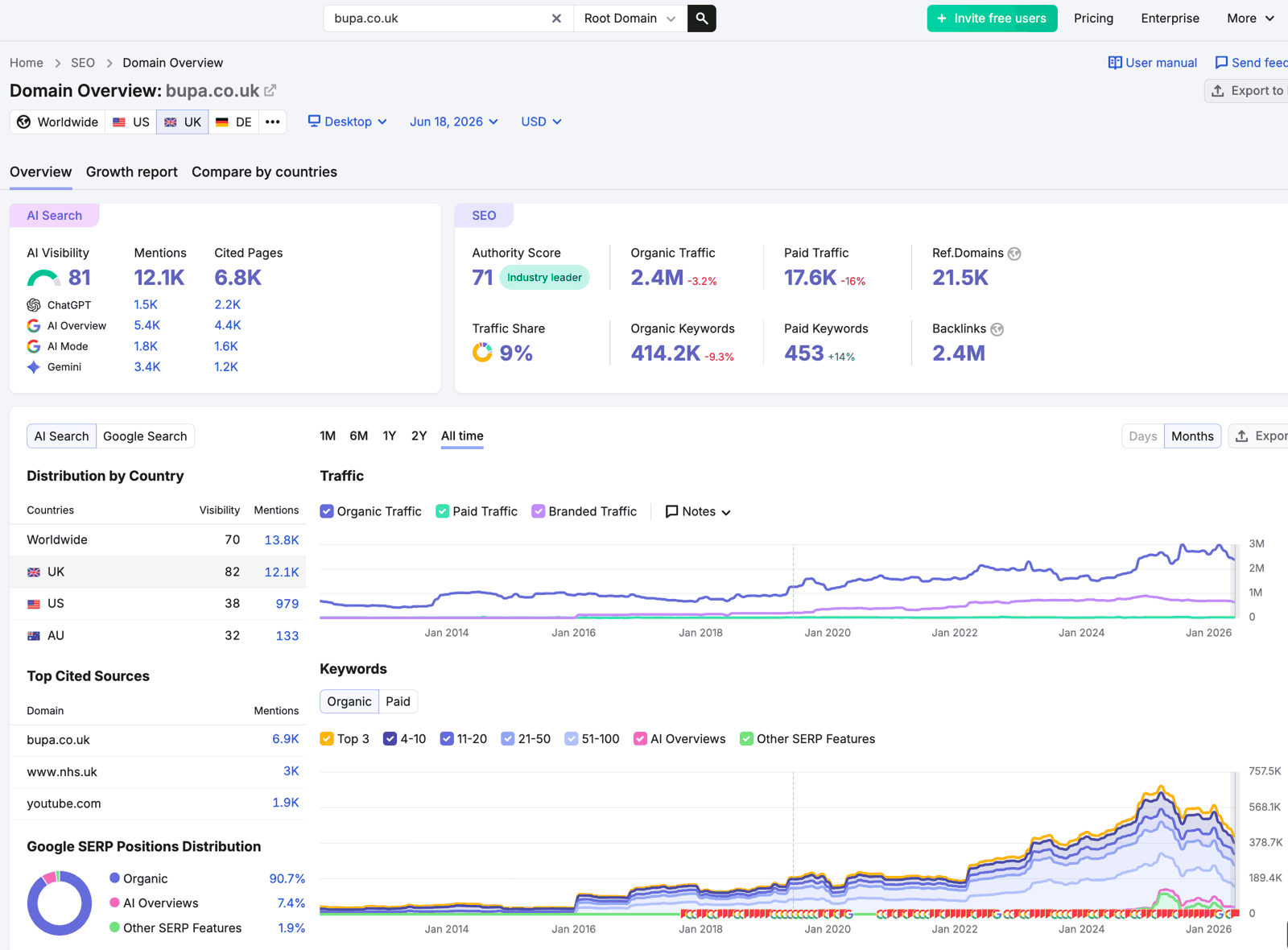
Digital Movement UK analysed the UK healthcare domain bupa.co.uk using the Semrush UK database, with figures collected on 18 June 2026. On that date bupa.co.uk drew 2.4 million organic visits a month from UK Google across 21,110 individual ranking pages and 414,200 ranking keywords, on a Semrush Authority Score of 71 out of 100 and 21,500 referring domains. About half of that traffic was branded: the term "bupa" alone returned bupa.co.uk at position one and sent roughly 88,000 visits a month. The other half came from non-branded health questions, where bupa.co.uk held position two for "bmi calculator" (673,000 UK searches a month) and position three for "electrolytes" (135,000 UK searches a month).
The subject is bupa.co.uk, the UK site of the healthcare provider Bupa. The analyst is Digital Movement UK, a London SEO agency with no commercial relationship with Bupa. Nothing here was supplied or reviewed by Bupa.
What the Semrush pull showed
Every figure below is one reading of the Semrush UK database for bupa.co.uk on 18 June 2026. Treat it as a dated snapshot.
Half brand, half health questions
Sorted by the traffic each term sends, the top keywords fall into two groups. The branded terms come with being a household name. The health questions were won page by page.
| Keyword | Type | Position | Traffic a month | Search volume |
|---|---|---|---|---|
| bupa | Brand | 1 | 88,000 | 110,000 |
| bupa dental | Brand | 1 | 26,500 | 33,100 |
| bupa login | Brand | 1 | 17,800 | 22,200 |
| bmi calculator | Health | 2 | 17,500 | 673,000 |
| vitamin d | Health | 6 | 12,100 | 550,000 |
| bupa health insurance | Buying | 1 | 11,800 | 14,800 |
| electrolytes | Health | 3 | 5,900 | 135,000 |
The mismatch on the health terms is the useful detail. Bupa held position two for "bmi calculator", searched 673,000 times a month, yet took only 17,500 visits from it. Position one and the calculator widgets inside the results page absorb the rest. Volume alone is a poor basis for choosing what to write.
One page ranking for 10,300 different searches
The most-cited number is not the traffic, but how few pages produce it.
Sorted by traffic, the biggest earners after the homepage are all single, comprehensive health guides. The BMI calculator page took 70,800 visits a month and ranked for 10,300 separate keywords on its own; the back pain guide took 52,800 visits and ranked for 3,200. We measured that back pain guide by hand on the live site: 2,869 words across 21 sections and 24 sub-sections, with a clinical review dated October 2024 and the next set for October 2027.
That answers the obvious follow-up: how do 21,110 pages stay indexed when Google removes most large sites' thin pages? Because none of them is thin. The count is a by-product of covering a subject properly, not a target that was set and hit.
The same pages win the AI answers
Semrush records a separate AI visibility measure. On the same date, bupa.co.uk scored 81 out of 100, and 82 in the UK specifically.
The pages AI engines quote are the pages that already rank in Google; we found no separate mechanism. Clear structure, specific facts, credited authorship and a maintained review date earn a ranking and also make a page easy for a model to quote — which is why AI search optimisation is an extension of good SEO, not a separate discipline.
The method transfers. The moat does not.
Most of what drives these rankings is method, and method scales down. Some is twenty years of accumulated advantage, and that does not.
Four of the forces are decisions rather than budgets, and they work at thirty pages as well as at 21,110. Structure content as hub, category and page and link the siblings, so authority moves through a cluster. Choose depth over volume. Make expertise visible — named authors, credentials, review dates, sources — which costs nothing. Match the format to the intent: a calculator for a calculator query, a guide for a how-to.
Two things do not transfer. The brand accounts for roughly half the traffic and cannot be bought. The link position — 2.4 million backlinks from 21,500 distinct domains — is two decades of press and partnerships compounding. A smaller business competes around that, not against it, by targeting the specific, higher-intent questions large sites answer only in passing. That is the shape of most of the SEO programmes we run.
What the gap looks like from the other end
A separate pull, for scale.
Alongside the teardown we ran a Semrush domain overview for a single-site London dental practice in the same category: an Authority Score of 14 out of 100, an AI search visibility score of 0, and 168 referring domains, against Bupa's 71, 81 and 21,500. Its organic traffic was low and close to flat. These figures sit outside the teardown's dataset and carry no recorded collection date, so treat them as illustration rather than finding.
How this was measured, and what it does not show
- What was measured
- Organic search performance of one domain, bupa.co.uk: traffic, keyword and page counts, Authority Score, backlinks and referring domains, top keywords and pages, and AI search visibility.
- With what tool
- Semrush, United Kingdom database — Domain Overview, Organic Positions and Top Pages. Word counts, section counts and review dates were taken by hand from the live Bupa pages, not from the tool.
- When
- Semrush figures collected 18 June 2026. This summary published 28 July 2026.
- By whom
- Raoul (Alex) Müller, Founder, Digital Movement UK. No commercial relationship with Bupa.
Limitations, stated plainly. Semrush traffic figures are modelled estimates from keyword rankings and clickstream data, not measured analytics; the true number is known only to Bupa. Authority Score is a proprietary Semrush metric, not a Google signal. AI visibility scores are vendor estimates, and the engines behind them change without notice. One reading, one date, one domain, one market: this shows correlation, not causation. Deep, structured, reviewed pages sit alongside strong rankings here, but a single-domain study cannot prove one caused the other. The keyword and page tables are the top rows by traffic, not the full set.
The complete teardown
The full nine-section report adds the complete keyword and page tables, the five forces behind the rankings, the indexing analysis and a step-by-step playbook.
The full report is free but sits behind a short form: a name, an email address and a phone number before it opens. This summary page stays open, with no form.
Read the full Bupa SEO teardown — free, requires an email address. Or start at the Digital Movement UK home page.